
How the Retirement Calculator Works
Enter your current age, planned retirement age, current monthly expenses, expected inflation rate, current savings, monthly investment, expected returns before and during retirement, and your life expectancy.
The calculator first inflates your current monthly expenses forward to your retirement date, then works out the corpus you'd need at retirement to fund those (inflation-adjusted) expenses for the rest of your life, discounted at your expected post-retirement return.
It then projects your current savings and monthly investments forward to retirement to estimate your likely corpus, and compares the two to show a surplus or shortfall — along with the monthly investment that would close any gap.
Why Plan Your Retirement Corpus in Advance
- Turns a vague worry into a concrete number: instead of a general sense that you should be saving more, you get an actual target corpus and monthly investment figure to work toward.
- Reveals the true cost of waiting: because compounding rewards time in the market, running the numbers early often shows how a delay of even 5-10 years can significantly raise the monthly investment needed to reach the same goal.
- Accounts for inflation, not just today's expenses: many people underestimate retirement needs by planning around today's cost of living instead of what those same expenses will cost decades from now.
- Surfaces shortfalls while there's still time to act: a projected gap discovered at 35 is far easier to close through a higher SIP or longer working years than one discovered at 55.
- Supports better day-to-day financial decisions: knowing your required monthly investment helps you weigh other financial choices — a big purchase, a career change, an EMI — against your long-term retirement goal.
Formula Used
The required corpus is the present value (at retirement) of your inflation-adjusted expenses:
Required Corpus ≈ Future Monthly Expense × Annuity Factor(real rate, months in retirement)- Future Monthly ExpenseCurrent Monthly Expenses × (1 + Inflation)^Years to Retirement
- Real RateThe post-retirement return adjusted for inflation continuing during retirement
- Projected CorpusFuture value of current savings + future value of monthly contributions, both compounded at the pre-retirement return
Example Calculation
A 30-year-old planning to retire at 60 with expenses of 50,000/month today.
- Current Age / Retirement Age30 / 60
- Current Monthly Expenses50,000
- Expected Inflation6% p.a.
- Current Savings1,000,000
- Monthly Investment20,000
- Return Before / During Retirement12% / 7%
- Life Expectancy85
- A required vs. projected corpus comparison, with a surplus/shortfall and a suggested monthly investment.
Important Assumptions
- This calculator gives an estimate for planning purposes only — it isn't financial advice, and actual outcomes depend on real market returns, inflation and your personal circumstances, none of which can be predicted with certainty.
- Expenses are assumed to grow at the same inflation rate before and during retirement, and investment returns are assumed constant, which real markets rarely follow exactly.
- This calculator assumes the expected return rates you enter compound monthly at a nominal rate (annual rate ÷ 12), consistent with how most SIP-style calculators compute returns. Some calculators instead use the true effective annual compounding rate, which shows a slightly different projected and required corpus for the same inputs.
- The calculator doesn't account for other retirement income sources like a pension or government retirement scheme, taxes, healthcare cost inflation (which often runs higher than general inflation), or major one-time expenses.
- Consider speaking with a certified financial planner for a comprehensive retirement plan tailored to your situation.
Frequently Asked Questions
Guides & Articles
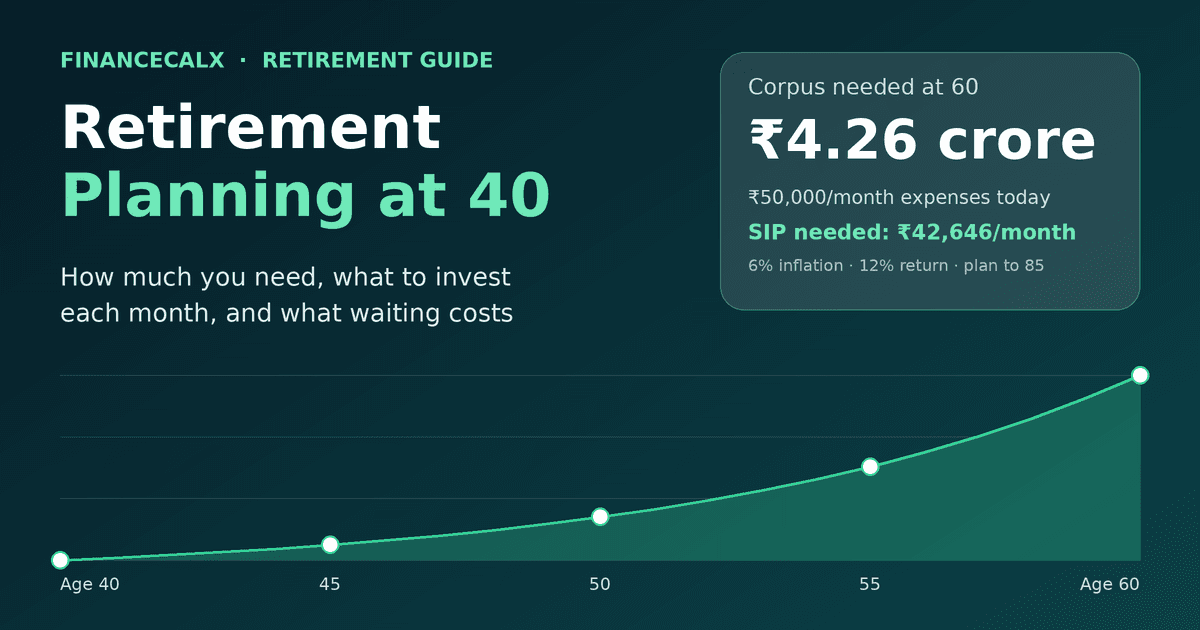
Retirement Planning at 40: A Complete Guide
A 40-year-old spending ₹50,000 a month needs about ₹4.26 crore at 60. Here is the monthly SIP to build it, what waiting five more years costs, and how savings, step-up SIP and retirement age change the number.