
How the SWP Calculator Works
This calculator simulates your investment balance month by month: each month, the remaining balance grows at your expected rate of return, then your fixed monthly withdrawal is deducted.
Enter your total investment corpus, the amount you wish to withdraw every month, your expected annual rate of return, and the number of years you plan to withdraw over.
You'll see your total withdrawals, the projected final balance, and a flag if your corpus is likely to run out before the end of your chosen period.
Benefits of an SWP
- Regular income: get a predictable cash flow at a frequency you choose, without redeeming your entire investment at once.
- Your money stays invested: only the withdrawn portion leaves the fund, so the remaining balance keeps earning returns.
- Potentially more tax-efficient than dividends: each withdrawal is treated as a partial redemption, so you're only taxed on the gains within that withdrawal, not the full payout.
- Flexible and reversible: you can change your withdrawal amount, pause, or stop an SWP at any time — unlike fixed annuities.
- Useful for retirement income: commonly used to convert an accumulated corpus (often built via SIP) into a steady monthly income stream.
Formula Used
Each month, the balance is first grown by the monthly rate of return, then the withdrawal is subtracted:
Balance(next) = Balance × (1 + i) − W- iExpected monthly rate of return (annual rate ÷ 12)
- WFixed monthly withdrawal amount
Example Calculation
Suppose you invest a lumpsum and withdraw a fixed monthly amount over 15 years, expecting an 8% annual return.
- Total Investment2,500,000
- Monthly Withdrawal20,000
- Expected Return Rate8% p.a.
- Withdrawal Period15 years
- Final Balance ≈ 1,347,000 (Total Withdrawn: 3,600,000)
Important Assumptions
- Returns are assumed to compound monthly at a constant rate for the entire withdrawal period — actual returns fluctuate with market performance.
- Withdrawals are assumed to happen as a fixed amount every month, with no adjustment for inflation.
- This calculator assumes the expected return rate compounds monthly at a nominal rate (annual rate ÷ 12), consistent with how most mutual fund calculators compute returns. Some calculators instead use the true effective annual compounding rate, which shows a slightly lower projected final balance for the same inputs.
- This calculator doesn't account for exit charges, fund fees, or capital gains tax on withdrawals.
- If the balance is fully depleted, withdrawals in later months are treated as zero.
Frequently Asked Questions
Guides & Articles
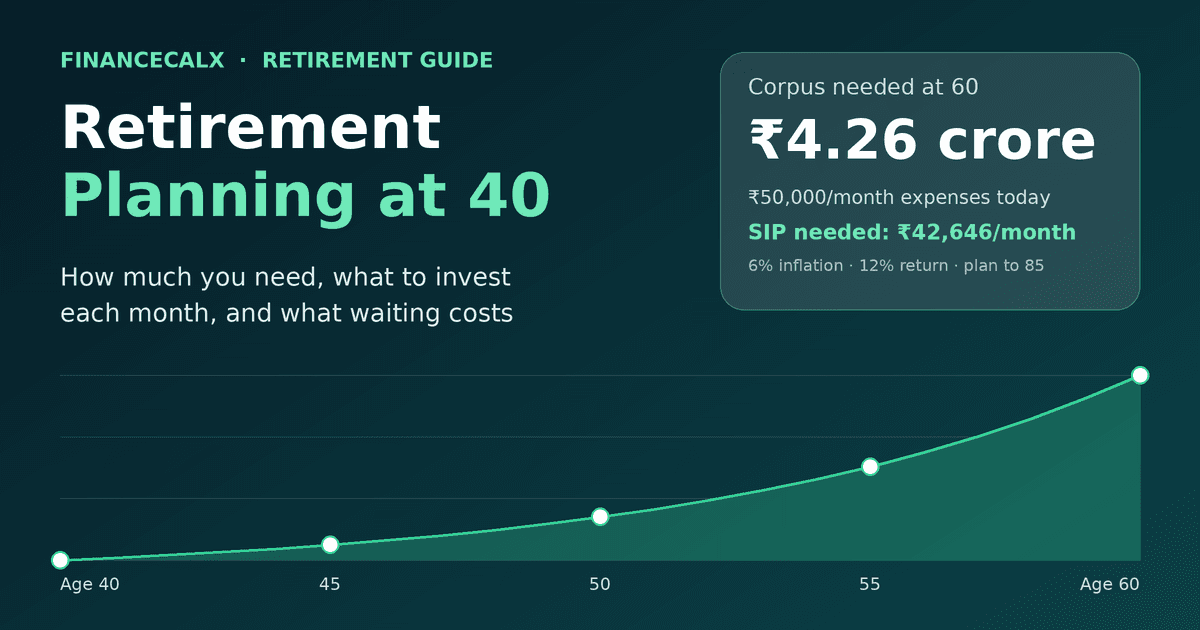
Retirement Planning at 40: A Complete Guide
A 40-year-old spending ₹50,000 a month needs about ₹4.26 crore at 60. Here is the monthly SIP to build it, what waiting five more years costs, and how savings, step-up SIP and retirement age change the number.
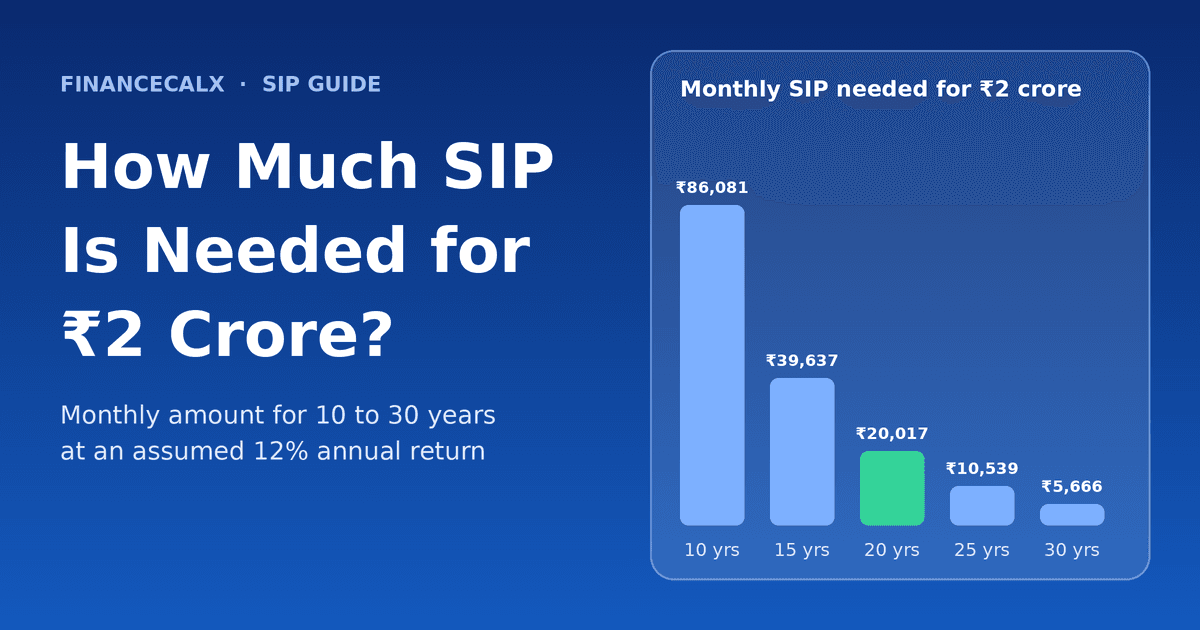
How Much SIP Is Needed for ₹2 Crore?
At 12% a year, about ₹20,017 a month for 20 years builds ₹2 crore. Here is the exact SIP amount for every time frame, how step-up SIP lowers it, and what ₹2 crore will really be worth after inflation.