
How the FD Calculator Works
This calculator compounds your deposit at the interest rate and frequency you choose. Quarterly compounding is a common convention, though many banks also offer monthly, half-yearly, or yearly options.
Enter the deposit amount, the annual interest rate your bank offers, the tenure in years, and how often interest compounds. You'll instantly see the interest earned and the maturity amount.
FD rates vary between banks and change over time, so this calculator uses the rate you enter rather than any live rate data — always confirm the current rate with your bank before investing.
Benefits of a Fixed Deposit
- Guaranteed, predictable returns: your interest rate is locked in at the time of booking, so your maturity amount is known upfront and doesn't fluctuate with market conditions — unlike mutual funds or equities.
- Capital safety: FDs are among the lowest-risk investment options available, since your principal isn't exposed to market volatility, making them a common choice for conservative investors and short-term goals.
- Flexible tenures: you can typically choose anywhere from a few months to several years, letting you match the FD's maturity to when you'll actually need the money.
- Higher rates for senior citizens: most banks offer an additional interest rate premium — commonly 0.25% to 0.75% higher — for senior citizen depositors, on top of the standard rate.
- Loan against FD: many banks let you borrow against your FD at a lower interest rate than an unsecured loan, so you can access funds in an emergency without breaking the deposit early.
Formula Used
The calculator uses the standard compound interest formula:
A = P × (1 + r/n)^(n×t)- AMaturity amount
- PPrincipal (deposit amount)
- rAnnual interest rate (as a decimal)
- nNumber of times interest compounds per year
- tTenure in years
Example Calculation
Suppose you deposit a lump sum in a 5-year FD with quarterly compounding.
- Deposit Amount100,000
- Interest Rate7% p.a.
- Tenure5 years
- CompoundingQuarterly
- Maturity Amount ≈ 141,478 (Interest Earned ≈ 41,478)
Important Assumptions
- Interest compounds at the frequency you select and is added back to the principal rather than paid out — this calculator models a cumulative FD, not one that pays interest out periodically.
- The interest rate you enter is assumed to stay constant for the entire tenure. Banks may offer different rates for different tenures or investor categories, such as senior citizens.
- This calculator doesn't factor in tax on the interest earned — FD interest is generally taxable, so check the rules that apply where you bank.
- Any penalty for withdrawing before maturity is not factored into this calculation.
Frequently Asked Questions
Guides & Articles
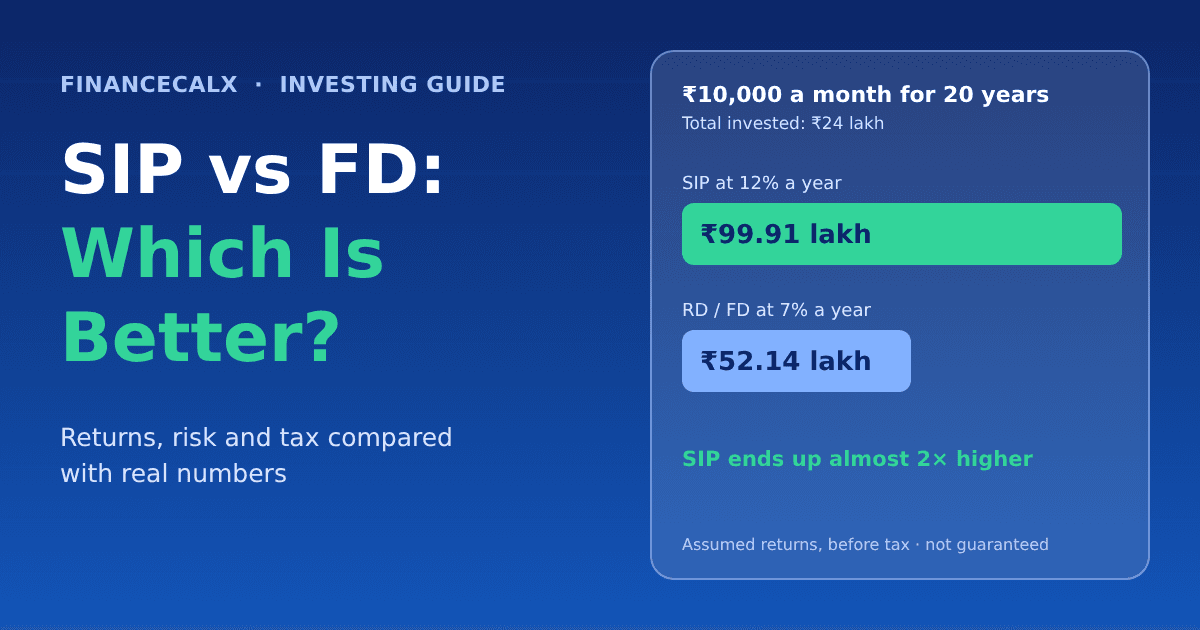
SIP vs FD: Which Is Better for You in 2026?
A ₹10,000 monthly SIP at 12% can reach ₹99.91 lakh in 20 years, against ₹52.14 lakh in a 7% recurring deposit. But SIPs carry market risk and FDs do not. Here is how to choose, with returns, tax and a simple split by goal.