How the Compound Interest Calculator Works
Enter your principal amount, the annual interest rate, the time period, and how often interest compounds (yearly, half-yearly, quarterly, or monthly).
You can also add a monthly contribution to see how regular top-ups speed up growth alongside your principal's compounding.
You'll get the total interest earned, the final amount, and a year-by-year growth table.
Why Compounding Matters
- Starting early beats investing more later: because growth compounds on itself, a few extra years at the start of your investment horizon often outweigh contributing significantly more money later on.
- Growth accelerates over time: compound interest grows exponentially, not linearly — the amount your money grows by in year 20 is far larger than in year 1, even at the same rate.
- Regular top-ups compound too: adding a monthly contribution means every rupee added also starts earning its own interest from the day it's added, not just your original principal.
- Small rate differences add up: over long periods, even a modest difference in annual rate — say 8% versus 10% — compounds into a meaningfully different final amount.
Formula Used
The principal grows using the standard compound interest formula:
A = P × (1 + r/n)^(n×t)- AFinal amount
- PPrincipal
- rAnnual interest rate (as a decimal)
- nCompounding periods per year
- tTime period in years
Example Calculation
A simple example with yearly compounding and no additional contributions.
- Principal100,000
- Interest Rate8% p.a.
- Time Period10 years
- CompoundingYearly
- Final Amount ≈ 215,892 (Interest Earned ≈ 115,892)
Important Assumptions
- The interest rate is assumed to stay constant for the entire period — real-world rates on savings and investment products can change over time.
- If you add a monthly contribution, it's projected using monthly compounding at the same annual rate, regardless of the compounding frequency you picked for the principal, since recurring monthly amounts are naturally modelled month by month.
- This calculator is for illustration and planning — it doesn't account for taxes, fees, or charges on real deposit or investment products.
Frequently Asked Questions
Guides & Articles
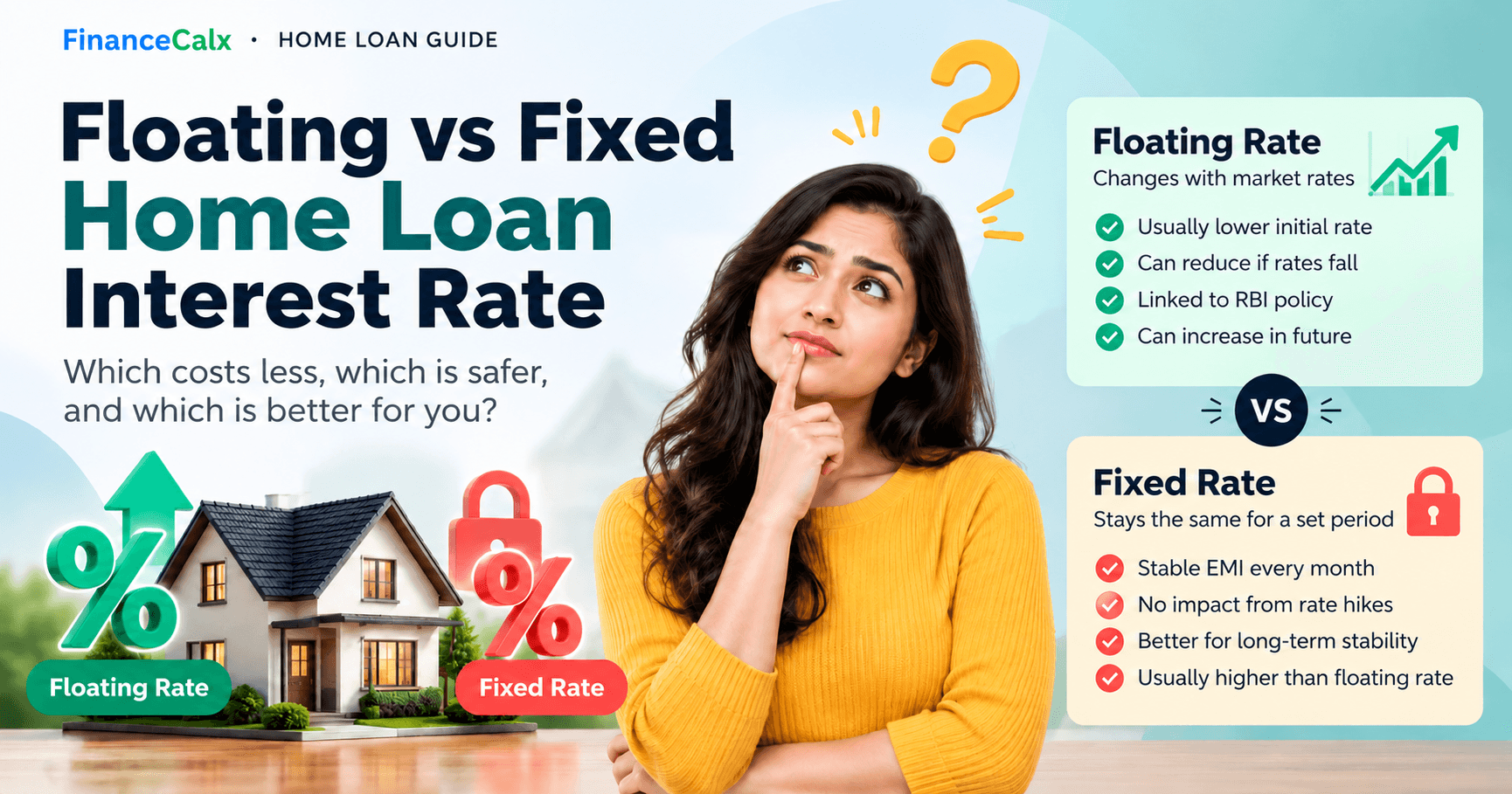
Floating vs Fixed Home Loan Interest Rate: Which Is Better?
On a ₹50 lakh, 20-year home loan, a 9.5% fixed rate costs ₹7.72 lakh more interest than an 8.5% floating rate that never changes. Here is when fixed still wins, what a rate rise does to your EMI, and how to choose.
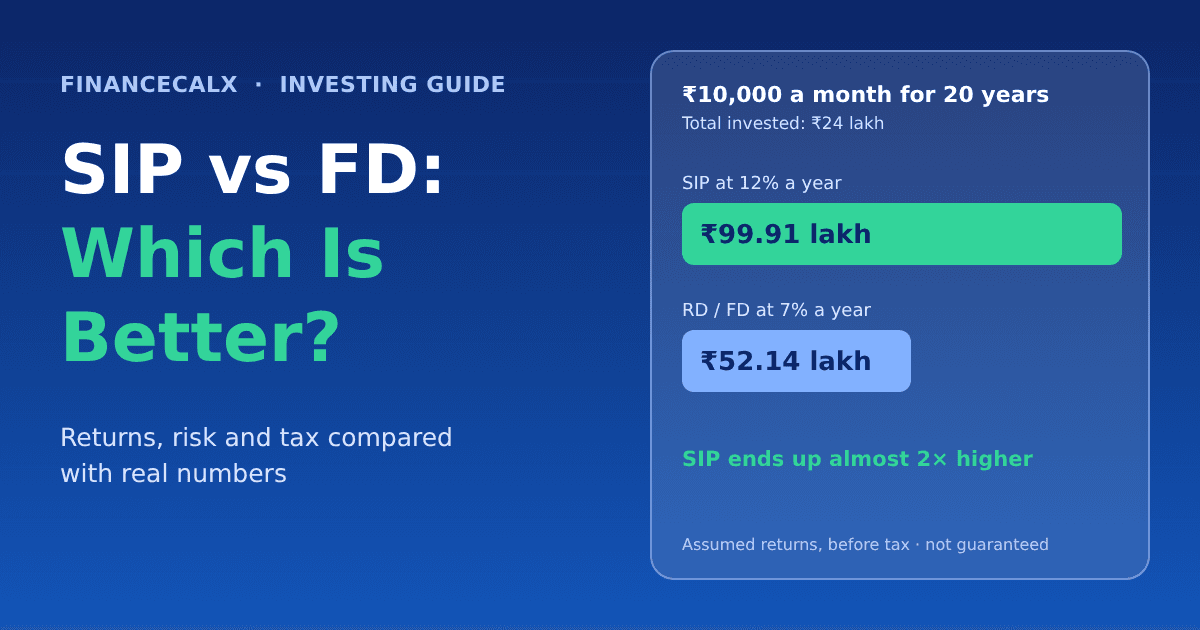
SIP vs FD: Which Is Better for You in 2026?
A ₹10,000 monthly SIP at 12% can reach ₹99.91 lakh in 20 years, against ₹52.14 lakh in a 7% recurring deposit. But SIPs carry market risk and FDs do not. Here is how to choose, with returns, tax and a simple split by goal.