How Much SIP Is Needed for ₹2 Crore?
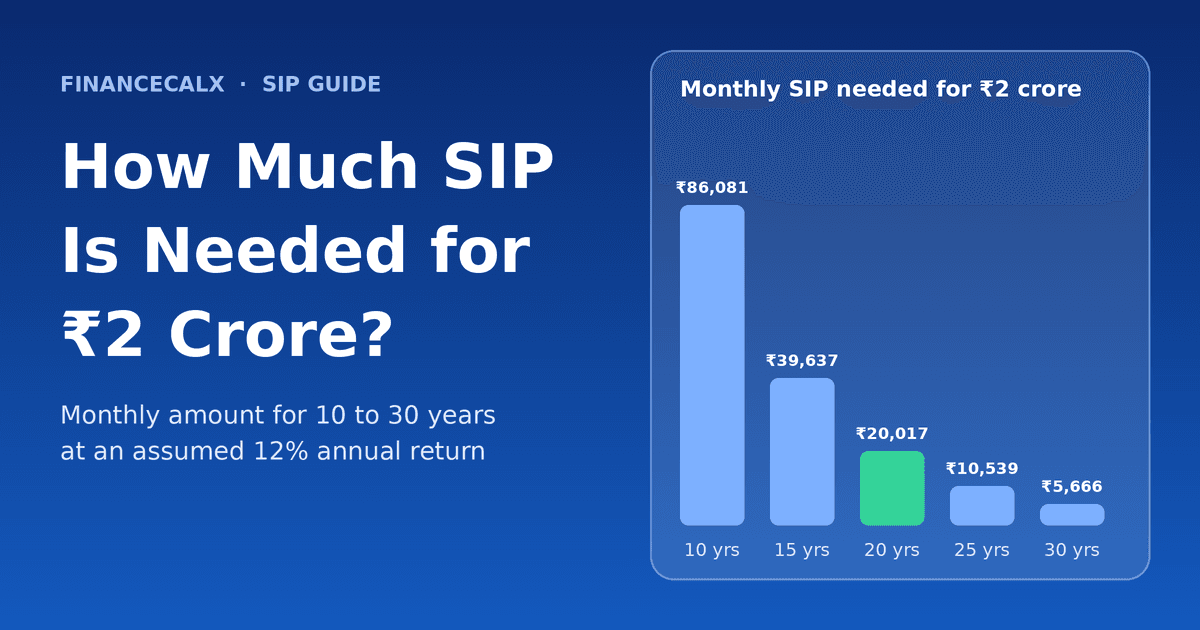
At 12% a year, about ₹20,017 a month for 20 years builds ₹2 crore. Here is the exact SIP amount for every time frame, how step-up SIP lowers it, and what ₹2 crore will really be worth after inflation.

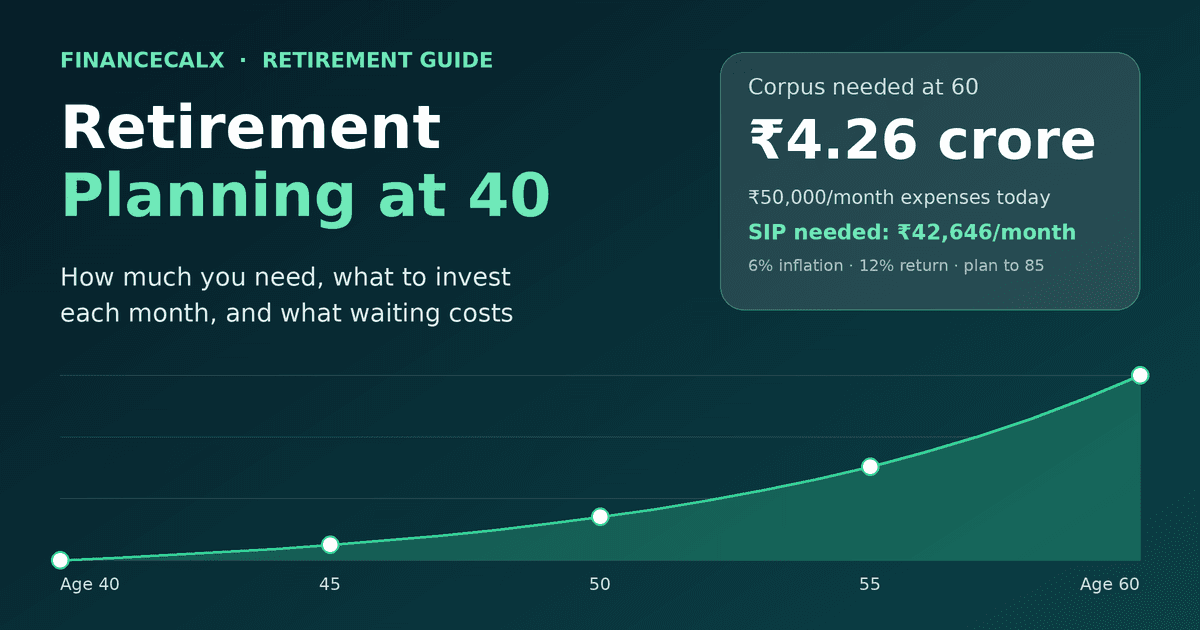
A 40-year-old spending ₹50,000 a month needs about ₹4.26 crore at 60. Here is the monthly SIP to build it, what waiting five more years costs, and how savings, step-up SIP and retirement age change the number.
Key takeaways
No. At 40 you still have about 20 working years, your income is probably near its peak, and big costs such as a home loan may be getting smaller. What you can't afford is another few years of waiting. The tables below use one example: you are 40, retire at 60, plan to live to 85 and spend ₹50,000 a month today. We assume 6% inflation, a 12% return before retirement and 7% after. These are assumptions, not promises, and you can change them in the free retirement calculator.
At 6% inflation, today's ₹50,000 becomes about ₹1,60,357 a month at 60. Paying that every month for 25 years, with prices still rising, needs a corpus of about ₹4.26 crore on retirement day. In today's money, that is only about ₹1.33 crore.
| Expenses today | Expenses at 60 | Corpus needed | Monthly SIP (no savings, 12%) |
|---|---|---|---|
| ₹30,000 | ₹96,214 | ₹2.56 crore | ₹25,588 |
| ₹50,000 | ₹1,60,357 | ₹4.26 crore | ₹42,646 |
| ₹75,000 | ₹2,40,535 | ₹6.39 crore | ₹63,970 |
| ₹1,00,000 | ₹3,20,714 | ₹8.52 crore | ₹85,293 |
| ₹1,50,000 | ₹4,81,070 | ₹12.78 crore | ₹1,27,939 |
The corpus grows in direct proportion to your expenses. If you expect to spend less in retirement, for example because your home loan will be repaid, your target falls by the same share.
Free toolRetirement CalculatorEnter your age, expenses, savings and returns to see your own corpus target and monthly SIP.Open calculator →Your EPF, PPF, NPS and retirement-earmarked mutual funds keep growing while you invest, so they reduce the SIP you need. For the ₹4.26 crore target:
| Savings today | Grows to by 60 (12%) | Monthly SIP at 12% | Monthly SIP at 10% |
|---|---|---|---|
| None | ₹0 | ₹42,646 | ₹55,649 |
| ₹10 lakh | ₹1.09 crore | ₹31,745 | ₹46,078 |
| ₹25 lakh | ₹2.72 crore | ₹15,392 | ₹31,723 |
| ₹50 lakh | ₹5.45 crore | ₹0 (on track) | ₹7,796 |
| ₹1 crore | ₹10.89 crore | ₹0 (on track) | ₹0 (on track) |
Test your own monthly amount and return in the SIP calculator.
Say you are 40 with ₹10 lakh invested and start a ₹20,000 SIP. At 12%, the savings grow to about ₹1.09 crore and the SIP to about ₹2.00 crore, a total of ₹3.09 crore. That leaves a shortfall of about ₹1.17 crore against ₹4.26 crore. To close it, the SIP must rise to about ₹31,745. At a 10% return, the same plan reaches only about ₹2.26 crore, which is why a plan that works only at the highest return is not a safe one.
Keeping the ₹4.26 crore target fixed and changing only your start age shows what time is worth:
| Start at age | Years invested | Monthly SIP needed | Total you invest |
|---|---|---|---|
| 30 | 30 | ₹12,071 | ₹43.46 lakh |
| 35 | 25 | ₹22,454 | ₹67.36 lakh |
| 40 | 20 | ₹42,646 | ₹1.02 crore |
| 45 | 15 | ₹84,447 | ₹1.52 crore |
| 50 | 10 | ₹1,83,396 | ₹2.20 crore |
Starting at 40 instead of 30 means paying about 3.5 times more each month. Waiting from 40 to 45 nearly doubles it, and starting at 50 needs more than four times as much as starting at 40. Compounding has less time to work, so the lesson is not to feel bad about the past, but to start this month.
If ₹42,646 a month is too much, raise your SIP by a fixed percentage each year as your salary grows:
| Yearly step-up | Starting SIP | SIP in the final year |
|---|---|---|
| None | ₹42,646 | ₹42,646 |
| 5% | ₹31,017 | ₹78,379 |
| 10% | ₹21,424 | ₹1,31,029 |
| Retire at | Years to save | Years in retirement | Corpus needed | Monthly SIP needed |
|---|---|---|---|---|
| 55 | 15 | 30 | ₹3.73 crore | ₹73,949 |
| 58 | 18 | 27 | ₹4.06 crore | ₹53,001 |
| 60 | 20 | 25 | ₹4.26 crore | ₹42,646 |
| 62 | 22 | 23 | ₹4.45 crore | ₹34,315 |
| 65 | 25 | 20 | ₹4.67 crore | ₹24,622 |
Retiring at 65 instead of 60 cuts the monthly SIP by about 42%, from ₹42,646 to ₹24,622. Retiring at 55 raises it by about 73%, to ₹73,949. The corpus changes only a little, but the years you have to build it change a lot, so working two or three extra years is often the cheapest lever.
| Assumption changed | Lower case | Base case | Higher case |
|---|---|---|---|
| Inflation: 5% / 6% / 7% | ₹3.14 crore | ₹4.26 crore | ₹5.80 crore |
| Return in retirement: 8% / 7% / 6% | ₹3.79 crore | ₹4.26 crore | ₹4.81 crore |
| Plan to age: 80 / 85 / 90 | ₹3.49 crore | ₹4.26 crore | ₹4.99 crore |
One extra point of inflation adds more than ₹1.5 crore, and living to 90 adds about ₹73 lakh. Plan for high inflation and a long life. The inflation calculator shows what today's costs will become.
Add your EPF, PPF, NPS and retirement-earmarked mutual funds together and enter the total as current savings in the retirement calculator. Leave out money meant for other goals, such as your child's education.
Your age, savings and expenses differ from this example, so try your own figures. All FinanceCalx calculators are free, need no sign-up and run in your browser, so nothing you enter is stored.
Free toolRetirement CalculatorSee your corpus target, projected savings and the extra monthly investment needed to close any gap.Open calculator →Retirement Calculator
Estimate the retirement corpus you'll need and whether you're on track.
CalculateSIP Calculator
Estimate the future value of your monthly SIP investments.
CalculateInflation Calculator
See how inflation affects the future cost and purchasing power of money.
CalculateNPS Calculator
Estimate your NPS retirement corpus, annuity and monthly pension.
CalculateEPF Calculator
Project your Employees' Provident Fund balance at retirement.
CalculatePPF Calculator
Estimate your PPF maturity value with a year-wise growth breakdown.
CalculateSWP Calculator
Plan systematic withdrawals from your mutual fund investments.
CalculateAt 12% a year, about ₹20,017 a month for 20 years builds ₹2 crore. Here is the exact SIP amount for every time frame, how step-up SIP lowers it, and what ₹2 crore will really be worth after inflation.