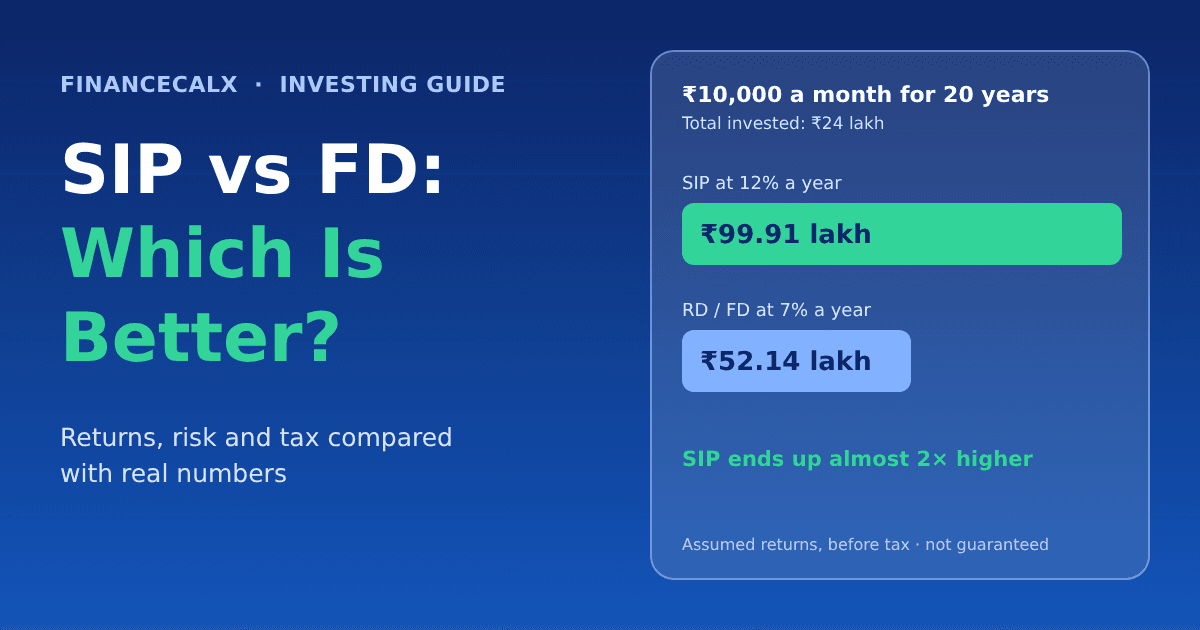
A ₹10,000 monthly SIP at 12% can reach ₹99.91 lakh in 20 years, against ₹52.14 lakh in a 7% recurring deposit. But SIPs carry market risk and FDs do not. Here is how to choose, with returns, tax and a simple split by goal.
FFinanceCalx Editorial Team··10 min read
Key takeaways
Neither is better for everyone. FD is for safety and goals under 3 years. SIP is for growth and goals 5 years or more away.
At assumed returns, ₹10,000 a month for 20 years becomes about ₹99.91 lakh in a 12% SIP and ₹52.14 lakh in a 7% recurring deposit, on the same ₹24 lakh invested.
FD interest is taxed at your slab rate every year. A 7% FD in the 30% slab earns only about 4.9% after tax, which is below 6% inflation.
SIP returns are not guaranteed. In a weak 5-year patch (3% a year), a SIP can end below a 7% RD. Time in the market is what protects you.
The short answer: SIP vs FD
If you can stay invested for 5 years or more, a SIP in an equity mutual fund has historically had the better chance of beating a fixed deposit, and of beating inflation. If you need the money in under 3 years, or you cannot bear to see your balance fall, an FD is the safer choice.
That is the whole decision in two lines. The rest of this guide shows the numbers behind it: returns, risk, tax, liquidity and a simple way to split your money between the two. You can check every figure in our free SIP calculator and FD calculator.
SIP vs FD at a glance
SIP (equity mutual fund) vs fixed deposit: key differences
Feature
SIP in an equity mutual fund
Fixed deposit (FD)
What it is
Invest a fixed amount every month in a mutual fund
Lock a lump sum with a bank for a fixed period
Return
Market-linked, not guaranteed (long-term assumption: 10–12%)
Fixed at booking, typically about 6.5–7.5% for most banks
Risk
Value can fall, especially in the short term
Very low. Bank deposits are insured up to ₹5 lakh per depositor per bank
Best for
Goals 5+ years away: retirement, child's education, wealth
Goals under 3 years, emergency fund, steady income
Minimum amount
Starts at a few hundred rupees a month
Usually ₹1,000 to ₹5,000, paid as a lump sum
Liquidity
Withdraw any time (no lock-in, except ELSS: 3 years)
Premature withdrawal allowed, usually with a 0.5–1% penalty
Tax
Equity gains over 12 months: 12.5% above ₹1.25 lakh a year
Interest taxed at your slab rate every year, even if not withdrawn
Beats inflation?
Likely over the long run, but not guaranteed
Often not, once tax is deducted
One thing is worth saying early: SIP and FD are not the same kind of thing. A SIP is a way of investing (a fixed amount, every month). An FD is a product (a deposit with a bank). The fair comparison is therefore a SIP in an equity fund against a monthly deposit in an FD or recurring deposit (RD).
Returns: ₹10,000 a month in a SIP vs an RD
Say you invest ₹10,000 every month. We assume 12% a year for the equity SIP and 7% a year for the bank deposit. These are not promises, just reasonable long-term assumptions:
₹10,000 a month: SIP at 12% vs RD at 7% (before tax)
Time period
You invest
SIP at 12%
RD at 7%
SIP advantage
5 years
₹6.00 lakh
₹8.25 lakh
₹7.19 lakh
₹1.06 lakh
10 years
₹12.00 lakh
₹23.23 lakh
₹17.37 lakh
₹5.86 lakh
15 years
₹18.00 lakh
₹50.46 lakh
₹31.77 lakh
₹18.69 lakh
20 years
₹24.00 lakh
₹99.91 lakh
₹52.14 lakh
₹47.77 lakh
25 years
₹30.00 lakh
₹1.90 crore
₹80.96 lakh
₹1.09 crore
Look at the gap. After 5 years the two are close, with ₹1.06 lakh between them. After 20 years the SIP is almost double the deposit. The reason is compounding: a higher rate matters more and more as the corpus gets bigger. You can try your own amount in the RD calculator and the SIP calculator.
Returns on a lump sum: ₹10 lakh in an FD vs equity
For a lump sum, here is ₹10 lakh in a 7% FD compared with an equity fund at 12%, and at a weaker 8%:
₹10 lakh invested once: FD at 7% vs equity fund (before tax)
Time period
FD at 7%
Equity at 8% (weak case)
Equity at 12%
5 years
₹14.15 lakh
₹14.69 lakh
₹17.62 lakh
10 years
₹20.02 lakh
₹21.59 lakh
₹31.06 lakh
15 years
₹28.32 lakh
₹31.72 lakh
₹54.74 lakh
20 years
₹40.06 lakh
₹46.61 lakh
₹96.46 lakh
Even the weak 8% case stays ahead of the FD, but only slightly. Compare your own amount with the lumpsum calculator.
Risk: the price you pay for higher returns
The higher return of a SIP is not free. Equity fund values rise and fall with the market, and a fall of 20–30% in a bad year is normal. Nobody can tell you in advance which years those will be.
Take a bad 5-year patch. If your SIP earned only 3% a year, your ₹6 lakh would grow to about ₹6.48 lakh. A 7% RD would have given you ₹7.19 lakh. In that case, the safe option clearly wins. The good news is that this risk shrinks with time. In our calculations, a SIP only needs to earn about 7% a year to match a 7% RD. Over 10 to 20 years, equity has usually done better than that, though it is never guaranteed.
Tax: what you actually keep
Tax is where many people get a surprise. FD interest is taxed every year at your slab rate, even if you do not withdraw it. For someone in the 30% slab, a 7% FD earns only about 4.9% a year after tax (including 4% cess). Banks also deduct TDS at 10% once interest crosses ₹50,000 a year (check it in our TDS calculator).
Equity mutual funds are taxed only when you sell. At the time of writing, gains on units held for more than 12 months are taxed at 12.5% above ₹1.25 lakh of gains in a financial year. Units sold within 12 months are taxed at 20%. Tax rules change, so check the latest ones.
₹10,000 a month: what is left after tax (30% slab investor)
Time period
SIP at 12% after tax
RD at 7% after tax
Difference
5 years
₹8.12 lakh
₹6.79 lakh
₹1.33 lakh
10 years
₹21.94 lakh
₹15.42 lakh
₹6.52 lakh
15 years
₹46.40 lakh
₹26.39 lakh
₹20.01 lakh
20 years
₹90.21 lakh
₹40.31 lakh
₹49.90 lakh
After tax, the RD's 20-year result falls from ₹52.14 lakh to ₹40.31 lakh, while the SIP drops from ₹99.91 lakh to ₹90.21 lakh. In other words, tax hurts FD savers far more. If you earn less and fall in a lower slab, the gap is smaller. You can see your slab in the income tax calculator.
Inflation: the quiet problem with FDs
With inflation at about 6%, a 7% FD looks like it gives you a 1% real return. After tax, that turns negative. A 4.9% after-tax return against 6% inflation means your money loses about 1% of buying power every year.
₹10 lakh invested once, after tax, in today's buying power (6% inflation)
Time period
FD at 7% (30% slab)
Equity fund at 12%
10 years
Worth ₹9.01 lakh in today's money
Worth ₹15.90 lakh in today's money
20 years
Worth ₹8.12 lakh in today's money
Worth ₹26.62 lakh in today's money
In both cases the FD ends up with less buying power than the ₹10 lakh you started with. It kept your rupees safe, but not their value. To see this effect for your own goal, try the inflation calculator.
Which one should you choose? A guide by goal
Matching your money to your time frame
Your situation
Better choice
Why
Emergency fund (3–6 months of expenses)
FD or liquid savings
Must be safe and available any time
Goal in under 3 years (car, wedding, holiday)
FD or RD
Not enough time to recover from a market fall
Goal in 3–5 years
Mix of both
Some growth, with a safety cushion
Goal in 5+ years (home, child's education)
SIP
Time smooths out market ups and downs
Retirement, 10–30 years away
SIP (equity-heavy)
Needs growth that beats inflation
Retired and need steady income
FD plus a systematic withdrawal plan
Stable interest, with some growth for later years
You do not have to pick one
Most people do best with both. The FD is your safety net and the SIP is your growth engine. A simple plan:
Build an emergency fund first. Park 6 months of expenses in an FD or a savings account.
Start a SIP for your long-term goals. Even ₹2,000–₹5,000 a month is a good start.
Raise your SIP every year. A 5–10% yearly step-up keeps pace with your income. See how much it helps in the SIP calculator.
Use FDs or RDs for short-term goals. Anything due within 3 years belongs here.
Review once a year. Check your goals, tax slab and FD rates.
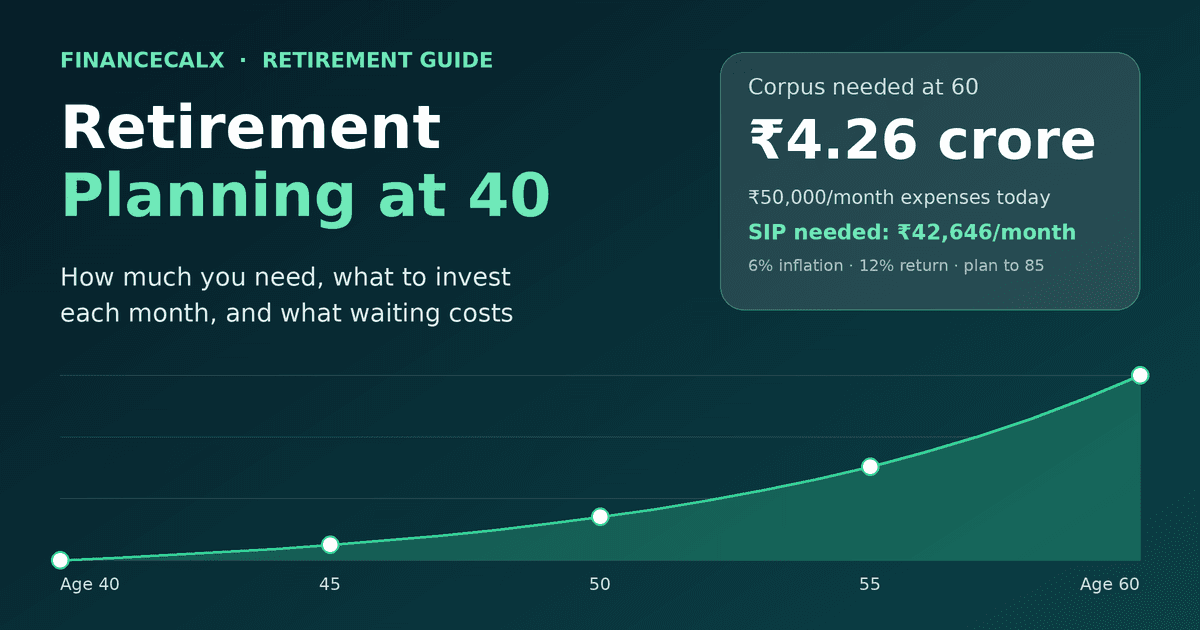
A 40-year-old spending ₹50,000 a month needs about ₹4.26 crore at 60. Here is the monthly SIP to build it, what waiting five more years costs, and how savings, step-up SIP and retirement age change the number.
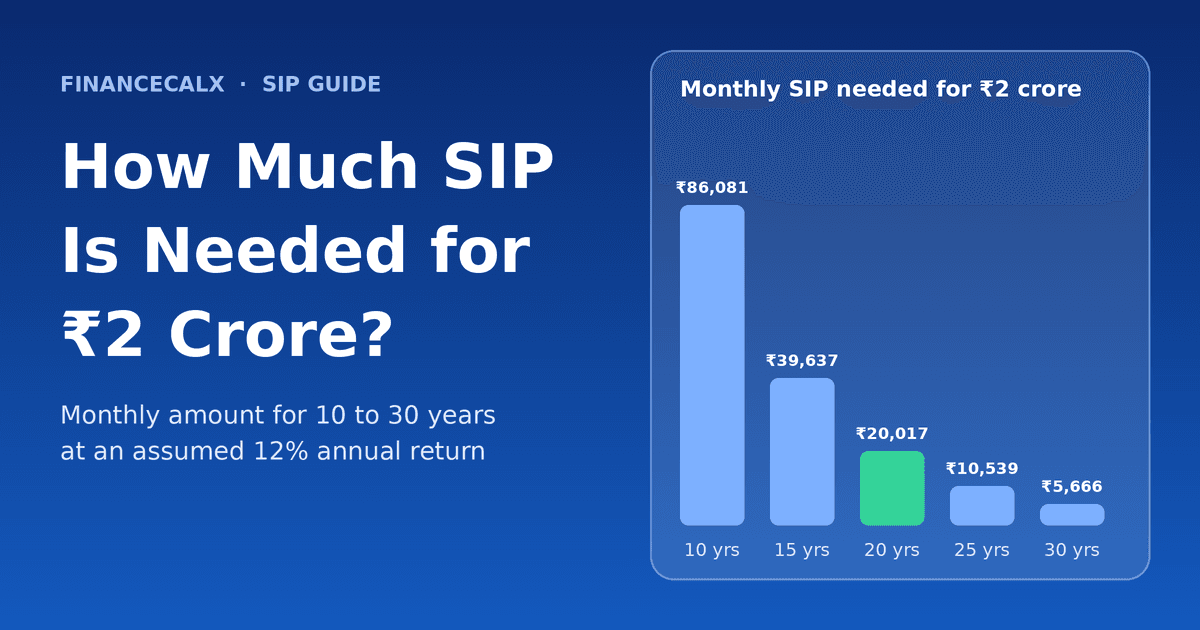
At 12% a year, about ₹20,017 a month for 20 years builds ₹2 crore. Here is the exact SIP amount for every time frame, how step-up SIP lowers it, and what ₹2 crore will really be worth after inflation.