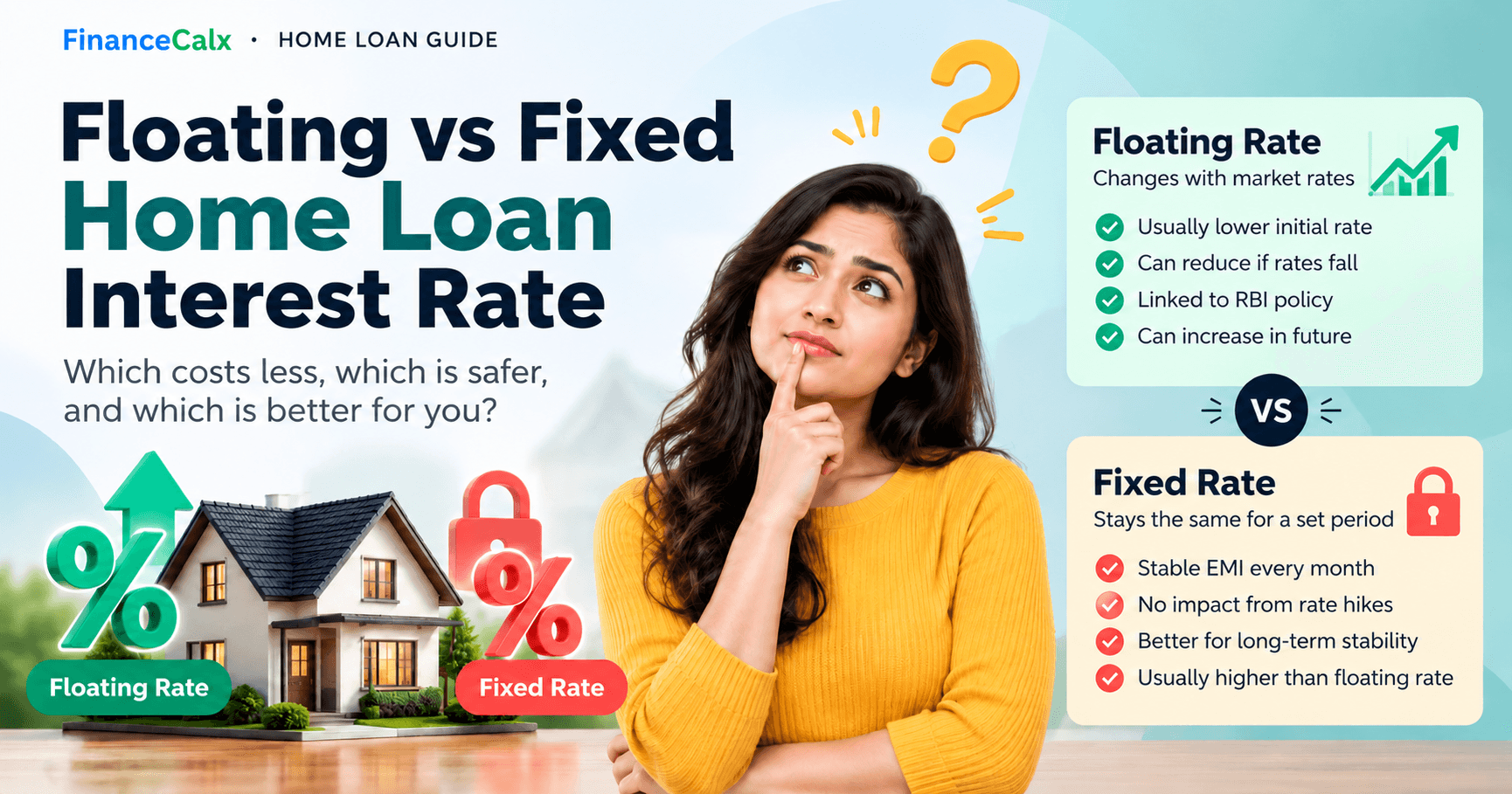
Floating vs Fixed Home Loan Interest Rate: Which Is Better?
On a ₹50 lakh, 20-year home loan, a 9.5% fixed rate costs ₹7.72 lakh more interest than an 8.5% floating rate that never changes. Here is when fixed still wins, what a rate rise does to your EMI, and how to choose.
FFinanceCalx Editorial Team··9 min read
Key takeaways
For most borrowers, floating is the better choice. It starts about 1–2% cheaper than fixed, falls when interest rates fall, and, at the time of writing, carries no prepayment charge for individuals under RBI rules.
On a ₹50 lakh, 20-year loan, a 9.5% fixed rate costs ₹7.72 lakh more than an 8.5% floating rate that stays put. The EMI is ₹46,607 against ₹43,391.
Fixed only wins if floating rates jump by more than 1 percentage point soon and stay high for the rest of the loan.
A floating loan carries risk. If your rate rises by 1% and you keep the same EMI, your loan can run 3 to 6 years longer.
The short answer: floating or fixed?
For most home buyers, a floating rate is the better choice. It starts lower, it goes down when interest rates go down, and you can usually prepay it without a penalty. A fixed rate makes sense only if you value a predictable EMI more than saving money, and you are willing to pay a higher rate for it.
This guide shows the numbers behind that advice: what the rate difference costs, what happens to your EMI when rates rise, and when fixed actually wins. You can check every figure in our free home loan EMI calculator.
Floating vs fixed home loan rate at a glance
Floating vs fixed home loan interest rate: key differences
Feature
Floating rate
Fixed rate
How the rate works
Linked to an external benchmark such as the repo rate, so it moves when the benchmark moves
Set at the start and does not change for the fixed period
Starting rate
Lower
Usually 1–2% higher than floating
Rate period
For the whole loan
Often only for the first 2–5 years, then it resets to floating
If rates fall
Your rate and EMI come down
You keep paying the old, higher rate
If rates rise
Your EMI or tenure goes up
You are protected during the fixed period
Prepayment
No prepayment charge for individuals under current RBI rules
Lenders may charge a prepayment fee
Best for
Most borrowers, especially for long loans
Borrowers who need a certain EMI and accept a higher cost
Two points are worth knowing. First, since October 2019 banks must link new floating home loans to an external benchmark such as the RBI repo rate, so your rate follows the market more openly than before. Second, many loans sold as "fixed" are fixed for only the first few years. After that, the rate usually becomes floating. Always ask the lender what happens at the end of the fixed period.
What the rate difference costs: ₹50 lakh over 20 years
Say you borrow ₹50 lakh for 20 years. A floating rate of 8.5% and a fixed rate of 9.5% are typical of the gap between the two. These are examples, not today's quotes from any lender:
₹50 lakh home loan for 20 years: floating 8.5% vs fixed 9.5%
Measure
Floating at 8.5% (rate unchanged)
Fixed at 9.5%
Fixed costs extra
Monthly EMI
₹43,391
₹46,607
₹3,215 a month
Total interest
₹54.14 lakh
₹61.86 lakh
₹7.72 lakh
A one percentage point higher rate costs you ₹7.72 lakh over the loan. That is your "price" for certainty. The real question is whether floating rates are likely to rise enough to wipe out that saving.
When does fixed beat floating? Five rate scenarios
Nobody knows where interest rates will go. So here is the same ₹50 lakh, 20-year loan under five possible paths for the floating rate, all compared with the 9.5% fixed loan (total interest ₹61.86 lakh):
Total interest if the floating rate changes (starts at 8.5%)
What happens to the floating rate
EMI at start
EMI later
Total interest
Compared with fixed
Falls to 7.5% after 3 years
₹43,391
₹40,606
₹48.46 lakh
Floating saves ₹13.40 lakh
Stays at 8.5%
₹43,391
₹43,391
₹54.14 lakh
Floating saves ₹7.72 lakh
Rises to 9.5% after 3 years
₹43,391
₹46,265
₹60.00 lakh
Floating saves ₹1.85 lakh
Rises to 9.5% after 1 year
₹43,391
₹46,498
₹61.22 lakh
Floating saves ₹0.63 lakh
Rises to 10.5% after 3 years
₹43,391
₹49,224
₹66.04 lakh
Fixed saves ₹4.18 lakh
Look at the pattern. Floating wins in four of the five cases, even when the rate rises by a full 1%. It loses only when the rate climbs a lot and stays high. The break-even points confirm it: floating has to reach about 9.6% within a year, about 9.8% within three years, or about 10.1% within five years, and stay there, before the fixed loan comes out ahead.
The risk of floating: what a rate rise does to your EMI
Floating is cheaper on average, but it is not comfortable if your budget is tight. Here is what higher rates do to the EMI on the same ₹50 lakh, 20-year loan, starting from 8.5%:
How your EMI changes as the rate rises (₹50 lakh, 20 years)
Interest rate
EMI
Increase from 8.5%
8.50%
₹43,391
Base case
8.75%
₹44,186
₹794 more
9.00%
₹44,986
₹1,595 more
9.50%
₹46,607
₹3,215 more
10.50%
₹49,919
₹6,528 more
Each 0.25% rise adds about ₹800 to your monthly EMI. Not many borrowers feel that straight away, because lenders often keep your EMI the same and quietly extend your tenure instead. The effect is large:
If your EMI stays at ₹43,391 and the rate changes, your loan tenure becomes
Rate change
New loan tenure
Rises to 9.5% straight away
25 years 9 months
Rises to 9.5% after 3 years
23 years 3 months
Rises to 10.5% after 3 years
30 years 5 months
Falls to 7.5% after 3 years
18 years
A 1% rise can add 3 to 6 years to a 20-year loan, depending on how early it happens, and a 2% rise after year 3 can add more than 10 years. This is the hidden risk of floating loans. Check your tenure on the lender's statement from time to time, and use the loan tenure calculator to see how long your loan will really run.
Which one should you choose? A guide by situation
Matching the rate type to your situation
Your situation
Better choice
Why
Long loan (15–30 years) and a stable income
Floating
Lower cost, and rate ups and downs even out over time
You plan to prepay the loan early
Floating
No prepayment charge, so extra payments cut interest fast
Tight budget with no room for an EMI rise
Fixed, or floating with a cushion
A certain EMI avoids stress
Rates are very high and may fall
Floating
You benefit automatically when they drop
Rates are very low and may rise
Fixed, for a short period
Lock in a low rate while it lasts
Short loan (under 7 years)
Either
The difference in total interest is small
If you choose floating, keep a cushion. Check that you could still pay an EMI that is 10–15% higher, which is about what a rise of 1.5–2% would cost. If you are unsure whether you qualify for the amount you want, try the loan eligibility calculator.
Can you switch later? Floating to fixed and back
Yes. Most lenders let you switch between floating and fixed, usually for a switching fee, and the new rate is the one they offer on the day, not your old one. You can also move your loan to another lender through a balance transfer if a better rate is on offer. Always compare the fee against the interest you would save.
Compare your rate with new borrowers' rates. If your lender charges old customers more, ask for a rate cut or a switch to the current benchmark-linked rate.
Prepay when you can. On a floating loan, every extra payment cuts your balance and interest. Test the effect in the loan interest calculator.
Review once a year. Check your rate, tenure and the benchmark, and act if your lender is charging more than others.
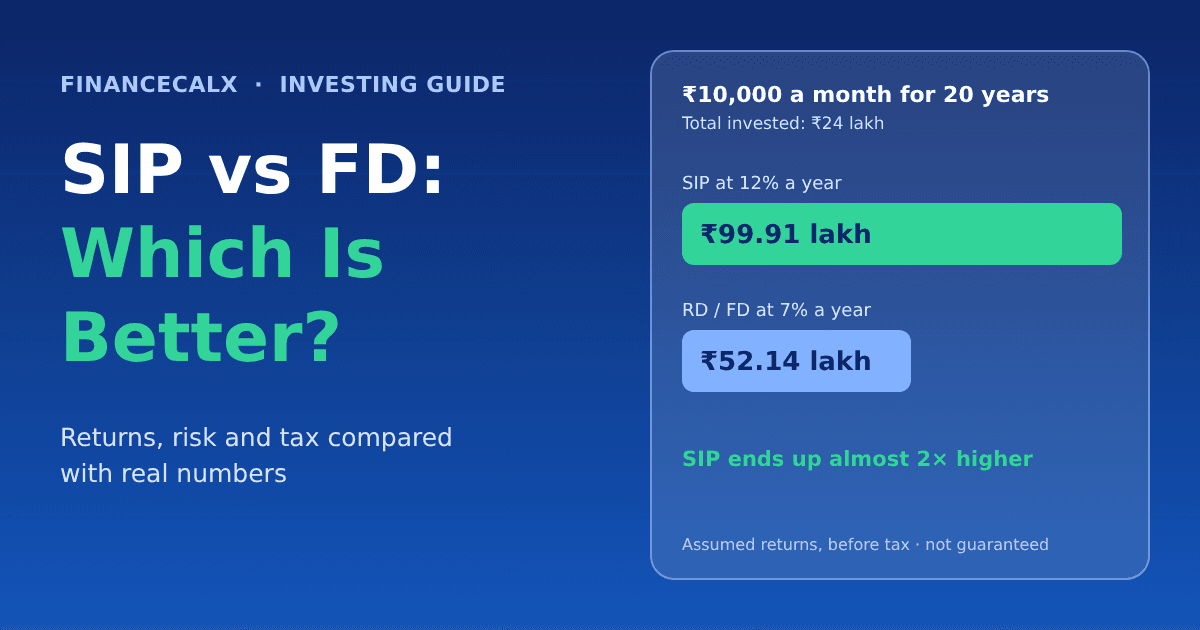
A ₹10,000 monthly SIP at 12% can reach ₹99.91 lakh in 20 years, against ₹52.14 lakh in a 7% recurring deposit. But SIPs carry market risk and FDs do not. Here is how to choose, with returns, tax and a simple split by goal.
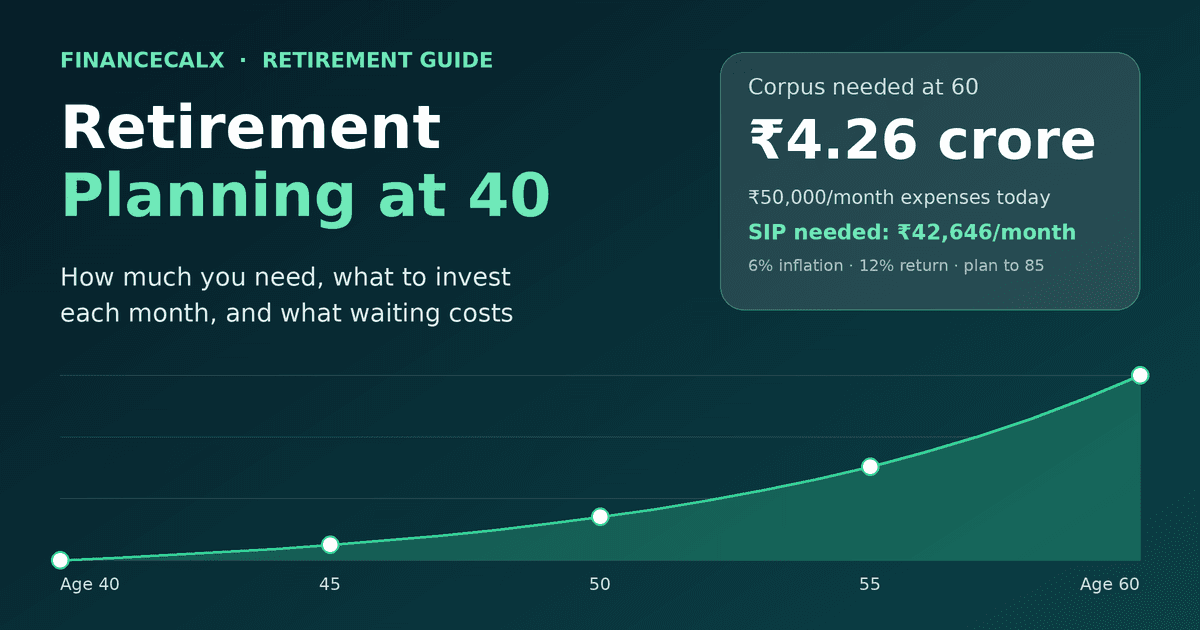
A 40-year-old spending ₹50,000 a month needs about ₹4.26 crore at 60. Here is the monthly SIP to build it, what waiting five more years costs, and how savings, step-up SIP and retirement age change the number.
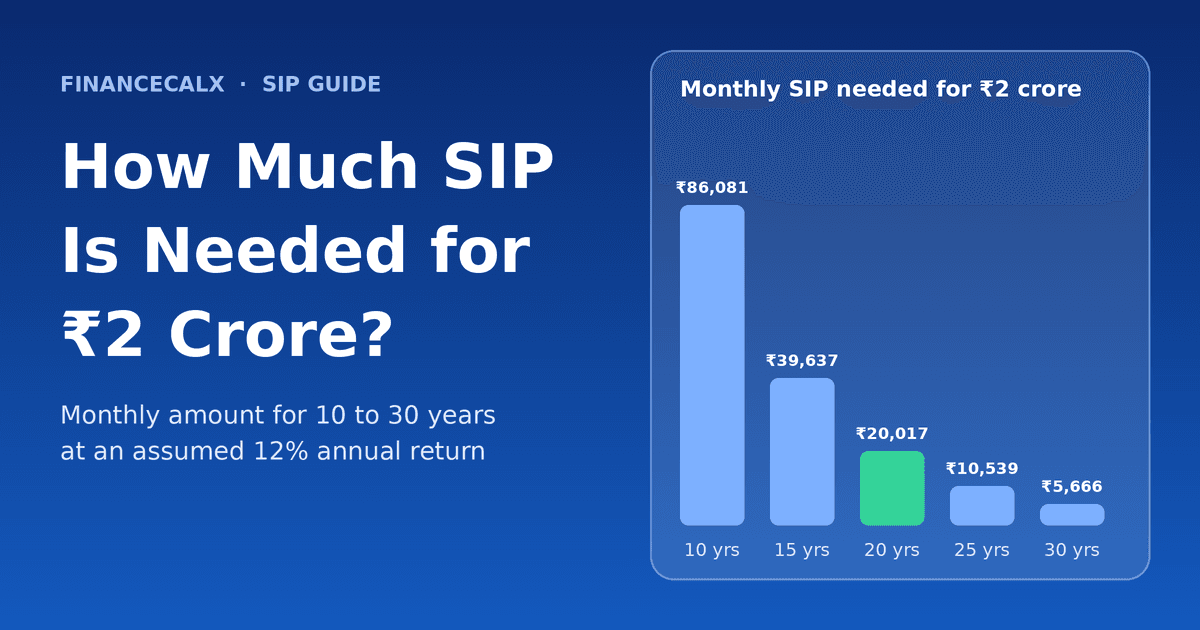
At 12% a year, about ₹20,017 a month for 20 years builds ₹2 crore. Here is the exact SIP amount for every time frame, how step-up SIP lowers it, and what ₹2 crore will really be worth after inflation.